The AI Productivity Curve
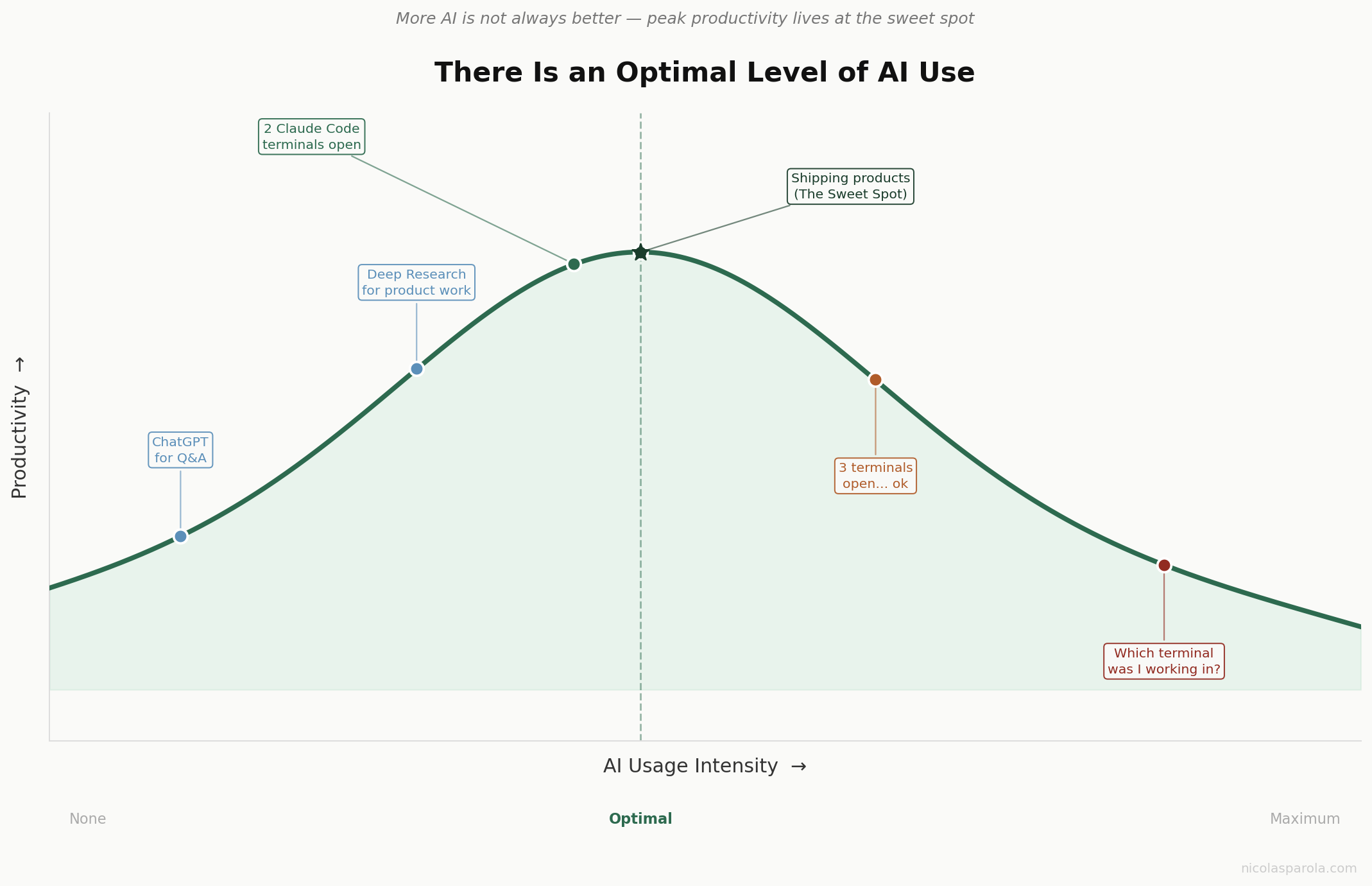
In 1908, Yerkes and Dodson discovered that performance follows a bell curve: too little stimulation and you’re sluggish, too much and you crash. Peak output lives in the middle.
The same applies to AI.
AI is not the bottleneck
Anthropic, Google, OpenAI — they have the infrastructure. The tokens are there. AI can work 24/7 without fatigue, without diminishing returns on its end.
The scarce resource is you. Your cognitive capacity is the ceiling.
The trap
Opening a second Claude Code terminal feels like a superpower. A third agent running in parallel — incredible. The momentum, the output, the dopamine — all real.
But at some point, quietly, the curve bends down.
You lose track of what each agent is doing. You approve a diff you don’t fully understand. You stare at four terminals wondering which one had the thing you were looking for.
And then you crash. Not dramatically — just completely.
The real skill
I used to think the new skill of the AI era was orchestration: knowing how to coordinate agents, tools, models.
That’s part of it.
But the harder skill is knowing when to stop. There’s no natural signal. The output keeps coming, the agents keep running — long after you’ve passed your own peak.
The limit isn’t technical. It’s human.
The bottleneck didn’t disappear. It just moved.